🔐 AWS Secrets Manager Advanced Security and Credential Management Project

A comprehensive AWS security project demonstrating advanced secrets management using AWS Secrets Manager, secure credential handling, GitHub secret scanning integration, Git repository security practices, and enterprise-grade application security patterns for protecting sensitive data in cloud environments.
Project Link: View Project
Author: Duc Thai
Email: ducthai060501@gmail.com
Duration: 2 hours
Difficulty Level: Advanced Security Implementation
🎯 Project Mission and Security Objectives
This advanced security project tackles one of the most critical vulnerabilities in modern application development: insecure credential storage and management. The project systematically demonstrates how to identify security vulnerabilities, implement enterprise-grade solutions, and establish secure development practices that protect sensitive data throughout the entire software development lifecycle.
Strategic Security Mission Components:
- 🔎 Vulnerability Discovery - Expose and analyze insecure credential storage practices that could lead to catastrophic security breaches
- 🤖 Automated Security Validation - Leverage GitHub's advanced secret scanning capabilities to catch sensitive information before public exposure
- 🔐 Enterprise Security Migration - Transform insecure hardcoded credentials into AWS Secrets Manager-based secure storage architecture
- ✅ Security Verification - Validate and prove that newly-secured code is safe for public sharing and collaboration
- 🚀 Professional Development - Master enterprise-level security practices for better sleep and career advancement
🛠️ Advanced Tools and Security Technologies
AWS Security Services Portfolio
- 🏦 AWS Secrets Manager - Enterprise-grade credential vault with automatic rotation and fine-grained access control
- 👥 AWS Identity and Access Management (IAM) - Comprehensive access key management and permission orchestration
- 🐙 GitHub Platform - Advanced code versioning, collaboration, and integrated security scanning
- 🐍 Python boto3 SDK - AWS service integration and programmatic secret retrieval
- ⚡ FastAPI Framework - High-performance web API development with security integration
Critical Security Concepts Mastered
- 🔐 Hardcoding vs. Secure Storage - Understanding why secrets never belong in code and enterprise alternatives
- 🔄 Automatic Secret Rotation - Implementing continuous credential refreshing to minimize security windows
- 🕵️♂️ Automated Secret Scanning - Leveraging GitHub's AI-powered detection to prevent public credential exposure
- 🚦 Advanced Git Workflows - Fork, clone, rebase, conflict resolution, and secure repository management
- 🐍 AWS Service Integration - Professional Python development with boto3 for cloud service interaction
- 🚀 Cloud Development Excellence - Enterprise-level security practices for professional cloud application development
💡 Project Reflection and Professional Development
Duration: Approximately 2 hours of intensive security implementation and Git workflow mastery ⏰
Most Challenging Technical Obstacle: The most complex aspect involved cleaning up commit history and safely removing hardcoded secrets from Git's historical record. Git rebase operations are incredibly powerful but require precision and expertise to avoid data loss or repository corruption. The challenge of completely eliminating sensitive data from version control history while maintaining repository integrity provided valuable real-world experience with advanced Git operations. 😅🌀
Most Rewarding Professional Achievement: Witnessing the application securely fetching credentials from AWS Secrets Manager and knowing the codebase was completely safe for public GitHub sharing was extraordinarily satisfying. The transformation from insecure hardcoded credentials to enterprise-grade secret management represented a significant advancement in cloud security expertise and professional development capabilities. 🚀🔐
Project Motivation and Timing Strategy: This project was undertaken as a strategic career development initiative, combining the desire to master advanced cloud security skills with overcoming procrastination through structured learning challenges. Starting the week with a technically demanding security project provided momentum and confidence for tackling complex challenges. The integration of AWS services, Python development, and GitHub workflows created a comprehensive learning experience that directly applies to enterprise development roles. 🏆✨
⚠️ Understanding Hardcoded Credential Vulnerabilities
Critical Security Risk Analysis
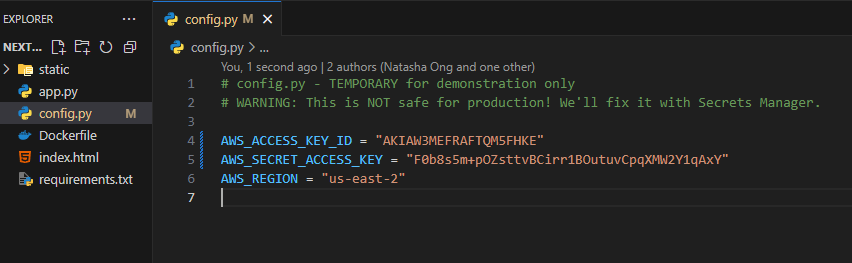
In this project demonstration, a sample web application dangerously exposes AWS_ACCESS_KEY_ID and AWS_SECRET_ACCESS_KEY directly embedded in the config.py file. This represents one of the most severe security vulnerabilities in application development.
Why Hardcoding Credentials Is Catastrophically Unsafe:
- 🚨 Public Exposure Risk - If this were a real, public application shared on GitHub, anyone could access these credentials instantly
- 💣 Complete Account Compromise - Exposed AWS credentials enable attackers to access your entire AWS account
- 🗂️ Data Theft Potential - Unauthorized access to delete resources, steal sensitive data, and cause irreparable damage
- 💰 Financial Impact - Attackers can provision expensive resources, resulting in massive unexpected bills
- 🔒 Universal Secret Risk - Database passwords, API keys, and any sensitive information should never be embedded in code
- 📋 Compliance Violations - Hardcoded secrets violate industry security standards and regulatory requirements
Demonstration Configuration Example
In the vulnerable config.py implementation, I included:
AWS_ACCESS_KEY_ID = "**************"
AWS_SECRET_ACCESS_KEY = "***********************************"
AWS_REGION = "us-east-2"
🎭 Important Security Note: These are intentionally fake AWS credentials—like movie props, designed for educational demonstration purposes only! These placeholder credentials won't actually connect to AWS or reveal real S3 buckets. They serve exclusively as examples of what not to do in production applications. Security education first, practical learning always! 🔐😄
Educational Value: This demonstration safely shows the vulnerability without actual security risks, enabling hands-on learning about credential security without compromising real AWS accounts or sensitive data.
🔧 Development Environment and AWS Integration
Professional Python Development Setup
As a project extension, I established a comprehensive development environment following industry best practices:
Development Environment Configuration
- Python Runtime Verification - Confirmed Python installation and version compatibility 🙌
- Virtual Environment Creation - Established isolated development environment for dependency management
- Clean Dependency Management - Separated project dependencies from system Python installation
Essential Package Installation
- 🐍 boto3 - AWS SDK for Python, providing comprehensive access to AWS services and APIs
- ⚡ fastapi - High-performance, modern web framework for building APIs with automatic documentation
- 🚀 uvicorn - Lightning-fast ASGI server for running FastAPI applications in production
- 📑 python-multipart - Advanced file upload handling for FastAPI applications
Architecture Benefits: This setup enables secure AWS service interaction, high-performance web API development, and professional file handling capabilities—all within a clean, isolated environment that prevents dependency conflicts and ensures reproducible deployments.
Real Credential Integration and Validation
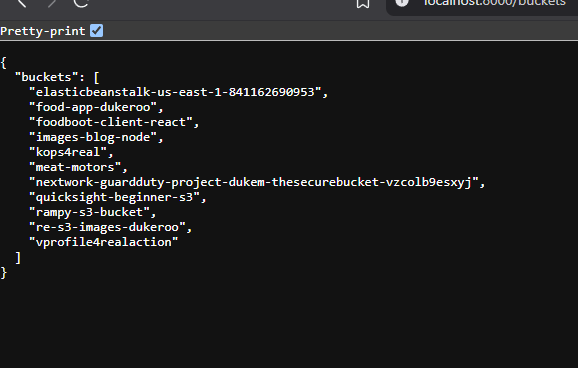
Initially, the application encountered an InvalidAccessKeyId error when attempting to view S3 buckets, confirming that the placeholder credentials couldn't access real AWS resources (as intended for security). 🚨
Issue Resolution Process:
- AWS Console Access - Logged into AWS account with administrative privileges
- IAM User Management - Navigated to Identity and Access Management console
- Access Key Generation - Created new programmatic access keys for the admin user
- Secure Credential Download - Downloaded credentials in CSV format for secure storage
Updated Configuration:
AWS_ACCESS_KEY_ID = "ACTUAL_ACCESS_KEY"
AWS_SECRET_ACCESS_KEY = "ACTUAL_SECRET_KEY"
AWS_REGION = "eu-north-1"
⚠️ Critical Security Warning: While this step demonstrates functionality, hardcoding real secrets remains extremely dangerous! This represents an intermediate step in the security transformation process—the next phase involves migrating to AWS Secrets Manager for enterprise-grade security.
🐙 GitHub Security Integration and Repository Management
Strategic Repository Forking
I created a fork of the original repository to establish an independent development environment where I could push changes, create pull requests, and experiment with security improvements without affecting the original codebase. 🍴😎
Fork vs. Clone Strategic Differences:
🍴 Fork Benefits (Selected Approach)
- GitHub Integration - Creates new repository under personal GitHub account
- Collaboration Enablement - Enables pull requests, code sharing, and community contributions
- Contribution Pathway - Provides mechanism for contributing improvements back to original project
- Professional Visibility - Showcases development work and security improvements publicly
- Backup and Redundancy - Maintains independent copy with full Git history
📥 Clone Limitations
- Local Only - Downloads repository to local machine without GitHub integration
- No Collaboration - Limited sharing and collaboration capabilities
- Contribution Challenges - Difficult pathway for contributing improvements back
- No Public Visibility - Work remains hidden without public showcase opportunity
Git Remote Configuration and Security Push
I configured the local repository to connect with my forked repository using professional Git workflows:
# Remove connection to original repository
git remote remove origin

# Connect to personal forked repository
git remote add origin <my-forked-repo-url>

# Stage all modified files for commit
git add .

# Create commit with descriptive message
git commit -m "Add hardcoded AWS credentials (security vulnerability demonstration)"

# Push changes to forked repository
git push origin main
GitHub Secret Scanning Protection
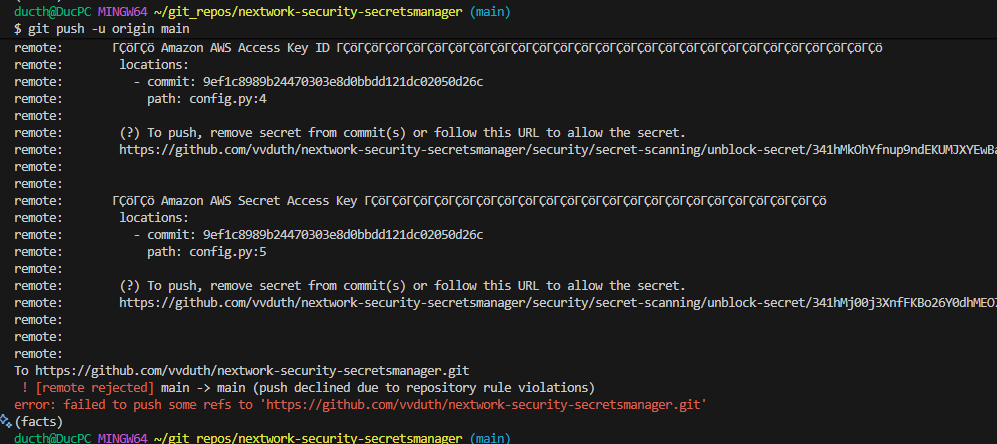
🦸♂️ GitHub's Advanced Security Defense: GitHub automatically blocked the push attempt because its sophisticated secret scanning system detected AWS credentials in the code! This represents GitHub's proactive security feature that hunts for sensitive information and prevents accidental credential exposure.
Security Protection Mechanisms:
- 🔍 AI-Powered Detection - Advanced pattern recognition identifies various credential types
- 🚫 Automatic Prevention - Blocks pushes containing detected secrets before public exposure
- 🛡️ Account Protection - Prevents AWS account hijacking through accidental credential leaks
- 🌍 Community Safety - Protects entire GitHub community from credential exposure risks
- 📚 Educational Value - Demonstrates importance of secure credential management practices
Professional Impact: This security blockade confirms GitHub's commitment to protecting developers and organizations from costly security mistakes. The feature keeps code public while maintaining secret privacy—a perfect balance of openness and security! 👏
🏦 AWS Secrets Manager Enterprise Implementation
Understanding Secrets Manager Architecture
AWS Secrets Manager functions as an enterprise-grade digital vault for sensitive information, providing comprehensive security, management, and compliance capabilities that far exceed simple credential storage.
Core Security Capabilities:
- 🔐 Advanced Encryption - Military-grade encryption for all stored secrets
- 🔄 Automatic Rotation - Scheduled credential updates without application downtime
- 👥 Fine-Grained Access Control - Precise permissions for who can access specific secrets
- 📊 Comprehensive Auditing - Complete access logging for compliance and security monitoring
- 🚀 Application Integration - Seamless integration with applications and AWS services
- 🌐 Cross-Region Replication - High availability and disaster recovery capabilities
Secret Rotation: Enterprise Security Best Practice
Secret rotation represents a fundamental security practice that automatically updates credentials on scheduled intervals, significantly reducing security exposure windows and minimizing the impact of potential credential compromise.
🔄 Rotation Benefits and Implementation:
- 🛡️ Attack Window Reduction - Regular credential changes limit the usefulness of stolen secrets
- 🏦 Zero-Downtime Updates - Applications continue operating during credential transitions
- 🤖 Automated Management - Eliminates manual credential management overhead and human error
- 📋 Compliance Alignment - Meets regulatory requirements for credential lifecycle management
- 🎯 Industry Applications - Essential for banking, e-commerce, and sensitive data environments
- 🔍 Hacker Mitigation - Keeps potential attackers guessing with constantly changing credentials
Developer Experience and Code Integration
AWS Secrets Manager dramatically improves developer productivity by providing pre-built code samples in multiple programming languages including Python, Java, JavaScript, and more! 🐍☕️💻
Developer Productivity Benefits:
- ⚡ Rapid Integration - Copy-paste code snippets for immediate implementation
- 🎯 Accuracy Assurance - Reduces integration mistakes and security vulnerabilities
- 🧙♂️ Accessibility - No need to be a security wizard to implement enterprise-grade protection
- 📚 Learning Resource - Educational examples for understanding best practices
- 🔐 Security Confidence - Pre-tested, secure integration patterns
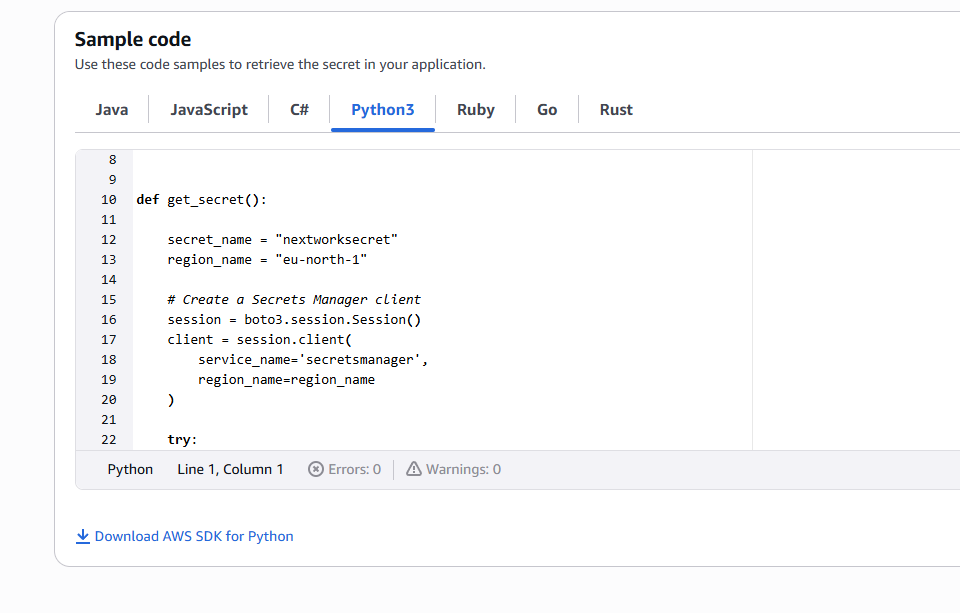
⚡ Advanced Application Code Transformation
Secure Configuration Upgrade
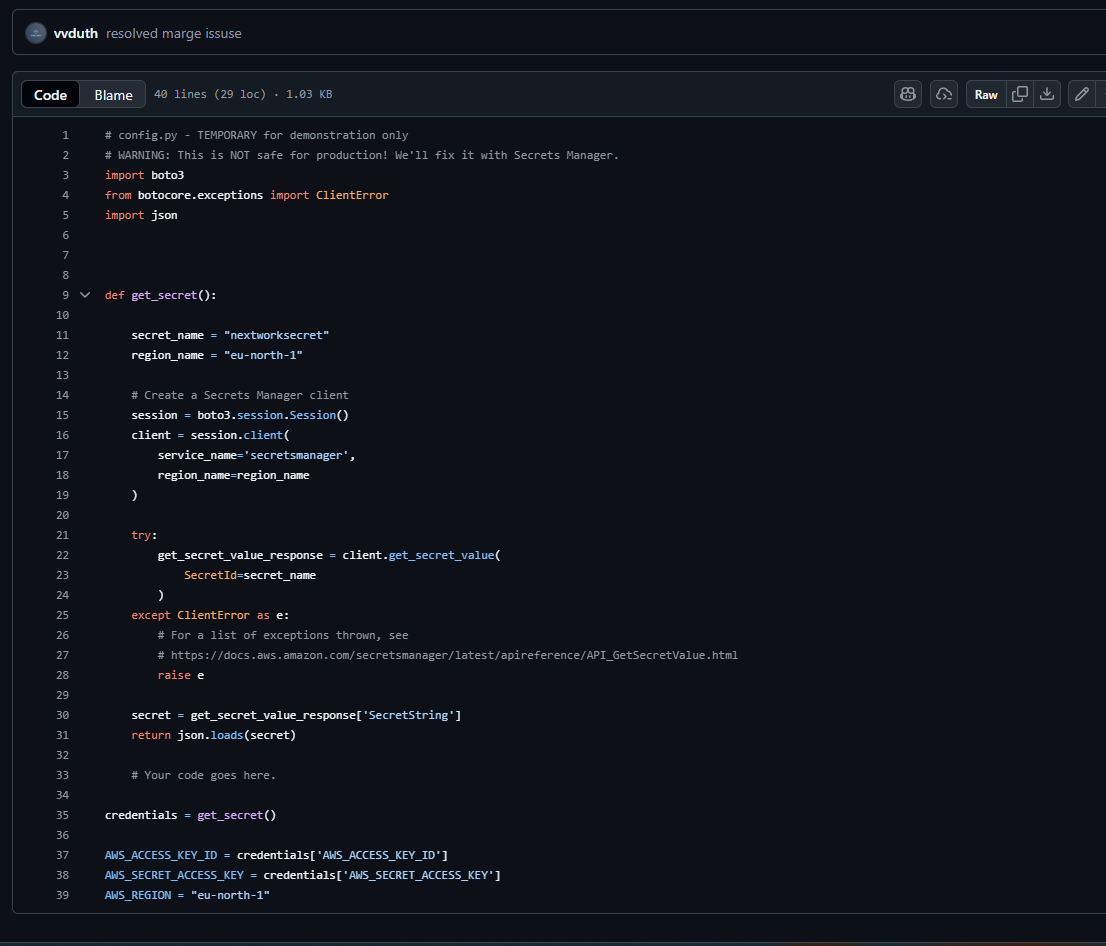
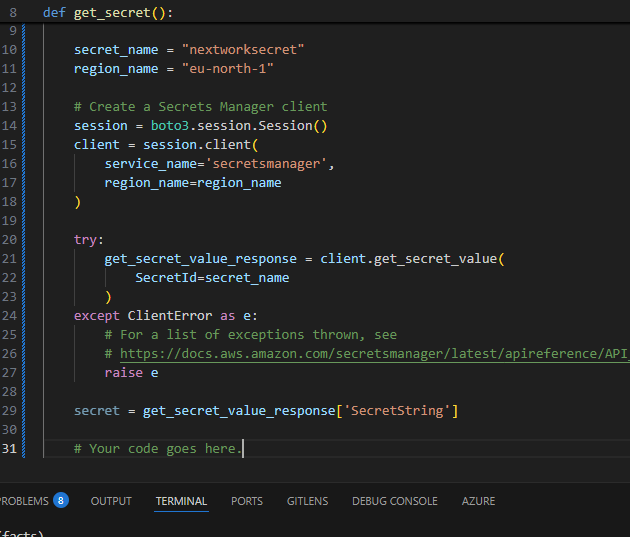
I completely transformed the config.py file to implement enterprise-grade security practices, replacing hardcoded credentials with secure AWS Secrets Manager integration.
Security-Enhanced Imports
import boto3
from botocore.exceptions import ClientError
Import Significance:
- 🪄 boto3 - AWS SDK providing comprehensive access to Secrets Manager APIs
- 🛡️ ClientError - Graceful error handling for secret retrieval operations, preventing application crashes
Secure Credential Retrieval Function
The new get_secret() function represents a complete paradigm shift from insecure hardcoded values to enterprise-grade secret management:
def get_secret():
    secret_name = "prod/myapp/database"
    region_name = "eu-north-1"

    # Create a Secrets Manager client
    session = boto3.session.Session()
    client = session.client(
        service_name='secretsmanager',
        region_name=region_name
    )

    try:
        get_secret_value_response = client.get_secret_value(
            SecretId=secret_name
        )
    except ClientError as e:
        # Handle specific error cases
        raise e

    secret = get_secret_value_response['SecretString']
    return json.loads(secret)
Security Architecture Benefits
- 🔐 Encrypted Transit - All communications with Secrets Manager use TLS encryption
- 🏦 Centralized Management - Credentials stored in secure, auditable AWS vault
- 🛡️ Error Handling - Robust exception handling prevents security information leakage
- 🔄 Dynamic Retrieval - Real-time credential access supports automatic rotation
- 📊 Audit Trail - All secret access logged for compliance and monitoring
Secure Credential Extraction
The updated application now securely extracts credentials from the Secrets Manager response:
credentials = get_secret()
AWS_ACCESS_KEY_ID = credentials['AWS_ACCESS_KEY_ID']
AWS_SECRET_ACCESS_KEY = credentials['AWS_SECRET_ACCESS_KEY']
AWS_REGION = "eu-north-1"
🚀 Transformation Impact: This architecture change eliminates hardcoded credentials, enables centralized secret management, supports automatic rotation, and provides enterprise-grade security without sacrificing application functionality. The application now fetches credentials directly from a secure vault, preventing accidental exposure and enabling sophisticated access control policies.
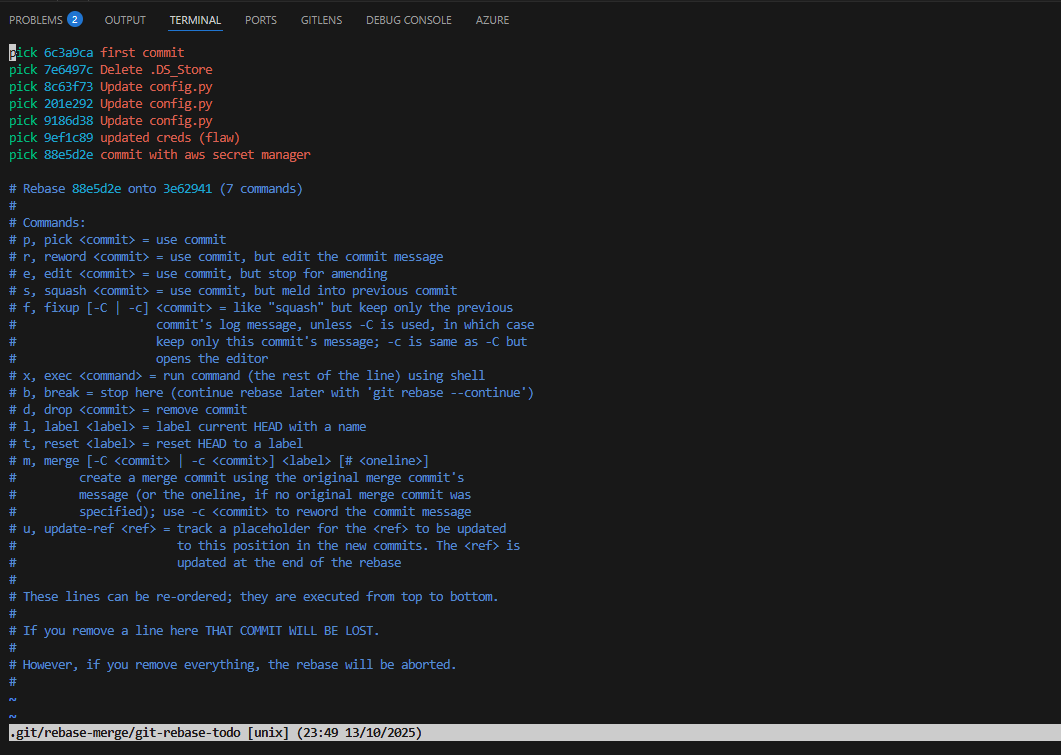
🕰️ Advanced Git Repository Security Cleanup
Understanding Git Rebasing for Security
Git rebasing provides powerful repository history modification capabilities, essential for security cleanup when sensitive data has been committed to version control.
Why Simple Editing Isn't Sufficient: Simply updating config.py to remove hardcoded credentials doesn't address the fundamental security issue—those credentials remain accessible in the Git commit history, where malicious actors could easily retrieve them using Git forensic techniques. 🕵️♂️
🔐 Security Rebasing Benefits:
- 📚 History Rewriting - Complete removal of sensitive data from all historical commits
- 🕰️ Timeline Cleanup - Eliminates evidence of credential exposure from repository timeline
- 🛡️ Forensic Protection - Prevents future discovery of historical credential leaks
- 🚀 Safe Sharing - Enables confident public repository sharing without security risks
- ⏰ Time Machine Security - Acts like a time machine for eliminating past security mistakes
Merge Conflict Resolution Expertise
During the rebasing process, merge conflicts occurred when Git attempted to combine changes affecting the same file sections (typically config.py). This represents normal behavior when multiple commits modify identical code regions.
Professional Conflict Resolution Process:
- 🔍 Conflict Analysis - Review conflicting changes and understand modification context
- 🎯 Decision Making - Choose appropriate code to retain, combining best elements when necessary
- ✂️ Marker Cleanup - Remove Git conflict markers (
<<<<<<<,=======,>>>>>>>) - 📦 File Staging - Stage resolved files for commit continuation
- 🚀 Process Completion - Continue rebase operation with resolved conflicts
Security Validation and Repository Cleanup
After completing the rebase operation, I performed comprehensive security validation to ensure complete credential removal:
Multi-Layer Security Verification:
- 📚 Commit History Audit - Reviewed entire repository commit history on GitHub
- 📄 File Content Analysis - Examined current
config.pycontents for credential residue - 🔍 Repository Search - Performed comprehensive search for old credential patterns
- ✅ Clean State Confirmation - Verified zero credential traces in any repository location
- 🚀 Public Safety Validation - Confirmed repository safety for public sharing and collaboration
🎉 Security Achievement: This comprehensive cleanup process ensures complete credential elimination, providing confidence that the repository contains no historical security vulnerabilities and is safe for public collaboration and professional portfolio inclusion.
🏆 Project Outcomes and Security Achievements
Successfully Implemented Advanced Security Features
✅ Vulnerability Identification - Successfully identified and analyzed hardcoded credential security risks
✅ GitHub Security Integration - Leveraged GitHub secret scanning for automated credential protection
✅ AWS Secrets Manager Implementation - Migrated from hardcoded credentials to enterprise-grade secret management
✅ Secure Code Transformation - Completely refactored application for secure credential retrieval
✅ Git Security Cleanup - Performed advanced repository history cleanup and credential removal
✅ Development Environment Mastery - Established professional Python development environment with security best practices
✅ Repository Security Validation - Confirmed complete elimination of security vulnerabilities from version control
✅ Public Sharing Safety - Validated repository safety for public collaboration and professional showcasing
Advanced Security Engineering Skills Demonstrated
- Credential Security Architecture - Advanced understanding of secure credential storage and enterprise security patterns
- AWS Security Services Mastery - Comprehensive knowledge of Secrets Manager, IAM, and security best practices
- Secure Development Practices - Professional application development with integrated security considerations
- Git Security Operations - Advanced Git workflows, rebasing, and repository security cleanup techniques
- Automated Security Integration - Leveraging GitHub security scanning and automated protection mechanisms
- Vulnerability Assessment - Systematic identification and remediation of application security vulnerabilities
- Enterprise Security Patterns - Implementation of scalable, auditable, and compliant security architectures
- Security Compliance - Understanding of regulatory requirements and industry security standards
🔍 Critical Security Insights and Professional Best Practices
Key Security Engineering Learning Points
- Never Hardcode Secrets - Credentials in code represent fundamental security vulnerabilities with catastrophic consequences
- Embrace Automated Security - GitHub secret scanning and similar tools provide essential early-warning security protection
- Implement Centralized Secret Management - AWS Secrets Manager enables enterprise-grade security with operational efficiency
- Practice Git Security Hygiene - Repository history cleanup prevents future security discoveries and vulnerabilities
- Validate Security Completely - Comprehensive testing ensures complete vulnerability elimination and safe collaboration
Enterprise AWS Security Best Practices
- Always Use Secrets Manager - Centralized secret storage with encryption, rotation, and access control
- Implement Least Privilege - Grant minimum necessary permissions for secret access and management
- Enable Automatic Rotation - Regular credential updates minimize security exposure windows
- Monitor Secret Access - Comprehensive logging and monitoring for compliance and security analysis
- Integrate Security Early - Build security considerations into development workflows from project inception
- Regular Security Audits - Periodic review of secret usage, permissions, and access patterns
- Disaster Recovery Planning - Cross-region secret replication and recovery procedures
🔄 Advanced Implementation and Enterprise Considerations
Enterprise Security Architecture
- Multi-Account Strategy - Secrets Manager deployment across complex organizational structures
- Cross-Service Integration - Integration with Lambda, ECS, EKS, and other AWS services
- Compliance Framework - Meeting SOC, PCI DSS, HIPAA, and other regulatory requirements
- Cost Optimization - Balancing security requirements with operational costs and efficiency
- Performance Considerations - Optimizing secret retrieval for high-performance applications
Advanced Development Integration
- CI/CD Pipeline Security - Secure credential management in automated deployment workflows
- Container Security - Secret injection for Docker and Kubernetes environments
- Microservices Architecture - Distributed secret management for service-oriented architectures
- Development Environment - Secure local development with cloud-integrated credential management
- Testing Strategies - Safe testing practices with mock secrets and isolated environments
📚 Advanced Security Learning Resources
AWS Security Documentation
- AWS Secrets Manager User Guide
- Secrets Manager Best Practices
- AWS IAM User Guide
- AWS Security Architecture
Security Development Resources
🤝 Project Impact and Professional Security Development
This AWS Secrets Manager Advanced Security and Credential Management project provided comprehensive, hands-on experience with enterprise-grade security engineering practices, demonstrating the complete transformation from vulnerable credential management to sophisticated, compliant secret handling architectures. The project showcased advanced technical skills in secure development, Git security operations, and AWS security service integration essential for modern cloud application development.
Professional Security Impact: Successfully identifying and remediating hardcoded credential vulnerabilities while implementing enterprise-grade alternatives demonstrates essential skills for security engineers, cloud architects, and senior developers. The project combines offensive security awareness (understanding vulnerabilities) with defensive security implementation (building secure solutions), providing comprehensive security engineering experience directly applicable to enterprise development environments.
Technical Achievement Significance: The complete elimination of security vulnerabilities from both current code and Git history, combined with implementing automated secret management, represents mastery of advanced security engineering practices. The integration of GitHub security scanning, AWS Secrets Manager, and sophisticated Git operations demonstrates skills essential for maintaining security in collaborative development environments.
Career Development Value: This project directly addresses real-world security challenges faced by organizations developing cloud-native applications. The demonstrated ability to identify vulnerabilities, implement enterprise solutions, and maintain security throughout the development lifecycle provides practical experience essential for senior development roles, security engineering positions, and cloud architecture responsibilities.
This project demonstrates advanced security engineering expertise essential for senior developers, security engineers, cloud architects, and DevSecOps specialists, showcasing comprehensive understanding of credential security, enterprise secret management, secure development practices, and advanced Git security operations required for building and maintaining secure, compliant applications in enterprise cloud environments.
Project Duration: 2 hours
Project Source: NextWork.org - Secure Secrets with Secrets Manager
Skill Level: Advanced Security Implementation
Contact: ducthai060501@gmail.com
This project showcases advanced AWS security expertise essential for secure application development, demonstrating comprehensive understanding of credential management, secret security, automated protection mechanisms, and enterprise security architecture required for building secure, compliant applications in professional cloud development environments.